
Evolved from the Brahmi script, Devanagari is used to write Marathi, Hindi, Sanskrit, and Nepali, and remains an important Indic script used in South Asia and beyond. Its technological advances have been slow, and design advances are just starting to pick up. South Asia, and specifically India, has a multilingual cultural landscape, and it is not uncommon for street signs, periodicals, newspapers, and other printed ephemera to typically use two to three languages—English and a regional language or two, or two to three regional languages together. While Indian street signs have long featured beautifully painted, built, or set Devanagari signs, often integrating Latin numbers or words seamlessly, translating this to digital typesetting has not been an equally easy task, owing to the differences in setting the two scripts, the difference in anatomy and reading of the scripts, and the limited availability of Devanagari fonts as compared to Latin. There are also knowledge gaps in multilingual typesetting where a script is often forced to follow Latin typesetting principles. This write-up aims to develop a guide for effectively setting Devanagari alongside Latin type, while honoring the nuances of both scripts.
Understanding the basics of Devanagari in contrast to Latin
The most successful use of Devanagari (with or without Latin) is when it’s not forced to be Latinized. Typesetting that relies on mechanized means must utilize available technology. The available technology is often centered around Latin Typesetting. So the tools and guidelines that work to create harmony and hierarchy in Latin typography do not necessarily work in Devanagari.
As a starting point to understanding how Devanagari works and why the principles of Latin typography cannot be applied to it, understanding the differences in its basic structure is important.
NOT ALPHABETIC: The Devanagari script consists of consonants and vowels with vowels attached to the consonants to create multiple combinations of letters that lead to form Phono-Graphic graphemes, as suggested by Bapurao S. Naik. For example, the ल (la) combined with े (e sound) becomes ले (le), or two conjuncts such as त (ta) and र (ra) can be combined into त्र (tra). From mechanical composition machines, to digital typesetting, almost all technology has been designed to serve alphabetic scripts which Devanagari has had to adapt to, or find creative solutions to, just to read correctly.
CASES: The Devanagari script only has a single case. Which means that the use of cases to establish contrast, for example, which works so well in Latin—small caps blending into a body, upper case headers, etc.—is not an option in Devanagari typesetting. All hierarchy and contrast is to be accomplished with a single case. Additionally, the Devanagari script may appear uneven, dense, or differently textured compared to its Latin counterpart when Latin uses capitalized words. Devanagari may also feel like an afterthought for this reason. Just font matching is not enough.
MATRAS AND ALIGNMENT: Devanagari uses matras above and below the active letter area. These may be comparable to Latin ascenders and descenders for alignment reasons. But matras are often not attached to letters, and are applied separately. In Latin, the baseline and x-height are used for optical alignment when typesetting, as the mass of letter weight falls between them. However, in Devanagari, the Shirorekha has considerable potential to carry the optical alignment, rather than the baseline. The Shirorekha may be used to align with the x-height of Latin as opposed to the Matra height. The x-height as such does not exist in Devanagari, instead, considering the mass between the Shirorekha and the base line is the norm.

SERIFS AND CONTRAST: The letter construction contrast in Devanagari is the opposite of Latin, and because there are no natural serifs historically, this means that the feel that a Roman capital construction serif in Latin would give is the same as a standard regular contrast in Devanagari. Serifs can feel decorative on Devanagari characters, so pairing them with a formal Latin serif may not work out. While a low contrast serif can be an excellent choice for long-form copy in Latin for ease of reading, the same is not necessarily true for Devanagari.
TRACKING AND SPACING: The Shirorekha, or the headline, is a strong element of the Devanagari script. The Shirorekha must always be connected unless it’s a stylistic choice to leave it disconnected. For this reason, any manual tracking changes must be made carefully to avoid creating unnecessary spaces in the Shirorekha in a word. The same can apply to kerning. Especially when justifying the two scripts, Devanagari cannot be forced to a Latin line length without considering its effect on the shirorekha.
DENSITY AND TEXTURE: Owing to the difference in anatomy, both scripts have a very different structure and density. This means that to work together, their overall density must be carefully matched. In long-form reading, this means matching the typographic color of paragraphs for equal weight and texture. In display type, this means considering the personality of a headline or a logotype and how that matches with its Latin counterpart. Often, even by global brands, generic or default Devanagari fonts are used as a match for display Latin headers or, say, custom Latin logotypes. The feel and personality of the display type can fall flat, especially when it appears on its own without the Latin header as the driving force.
Additionally, since matras and ukars are separately attached to the consonants, incorrect justification may lead to the detachment or displacement of matras.
Guidelines and Possible Solutions
Multilingual typesetting is more than simply pairing fonts. It requires the successful matching of fonts, ensuring all scripts receive equal space, importance, and respect, while also achieving correct readability and legibility across all languages. While more display Devanagari fonts and educational advances in Devanagari will be important, it is also important for digital typesetting to diverge from Latin typesetting rules and instead learn from hand-painted precedents, find solutions specific to the Latin script, and respect the scribal history of Devanagari. A parallel to consider is how guidelines for contemporary Latin Typography derive from its calligraphic tradition and metal typesetting.
FONT MATCHING: When font matching Devanagari with Latin, both languages must be equivalent to each other, without one language being secondary, which is often the case with Devanagari. The easiest and most foolproof way of doing this is by selecting a font family that offers both Devanagari and Latin support. When this is not an option, matching stroke weight and terminal shapes, along with contrast types, can be a good starting point. Standard contrast serif Latin fonts, for example, would match well with standard contrast Devanagari. Even if the contrast in both scripts is the opposite. A quick visual comparison between the Latin letter ‘o’ and Devanagari letter ‘क’ can be helpful when selecting fonts. To go one step further, studying the letter widths of both fonts to match widths, and match x-heights of Latin letterforms with the main body height for Devanagari. Keeping anatomy comparable can help with this kind of matching. This also involves comparing the white spaces inside letterforms and the spaces between two letters to understand the color and texture in the two scripts, both at a scaled-in level and at an at-large level.

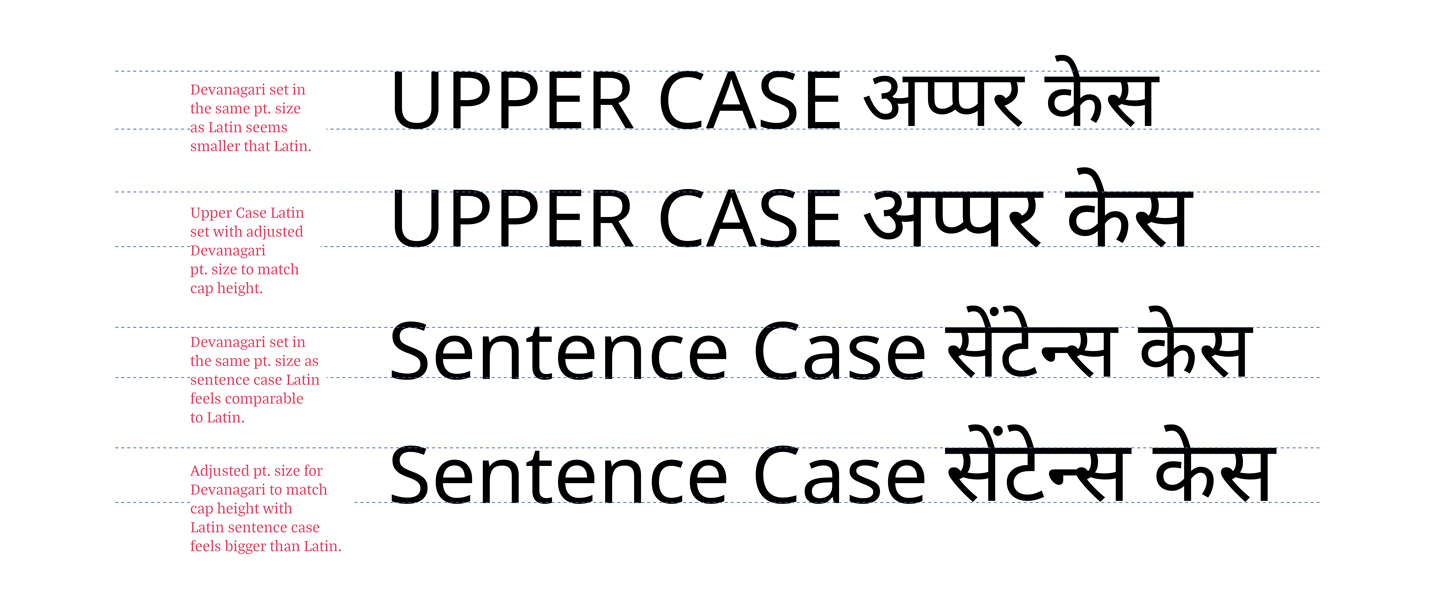
HIERARCHY AND ALIGNMENT: With the absence of cases, italics, or underlines, creating hierarchy while working with Devanagari must rely on an understanding of the weight distribution of the font in use. The cap height in Latin could be comparable to the upper matra height in Devanagari, or in some cases (depending on the font and the use case) the shirorekha height in Devanagari. The x-height in Latin can also be comparable to the shirorekha height in Devanagari because of an equally imposing horizontal weight in both cases. In the second instance, Matra texture on top in Devanagari must be taken into consideration to see how it may fit with the Latin counterpart. Pairing all caps Latin may look very heavy if there are not many matras in the Devanagari counterpart. In such cases, matching a sentence case Latin will fit better where the ascenders and descenders feel similar in weight to the matras and ukaars in Devanagari. While mixed cases in Latin can match the texture of Deavanagari well, instead of mathematically aligning, optical alignment and overhangs should be way to go. When aligning baselines, the ukars and lower matras must be treated like descenders in Latin.
To create a successful hierarchy and contrast in Devanagari, changing the scale to match upper case latin could be a starting point. That may not be sufficient, however, and another solution could be introducing a second font within Devanagari to match a stylized Latin counterpart such as the upper case or the Italic.


Devanagari, like Latin, is read from left to right. So a left aligned, ragged right paragraph alignment works well for long-form reading in both scripts. Justifying Devanagari type can be very tricky, however. Good justification relies on adding letter spacing, word spacing and hyphenation. Hyphenation is not traditionally used in Devanagari, and adding letter spacing may create incorrect gaps in the Shirorekha.
SPACING: Devanagari may require additional line spacing as compared to the Latin script. So when working together, instead of relying on automated leading, a typographer should carefully control line spacing in a paragraph to create even spacing across the paragraph. If and when kerning, the Shirorekha should be well considered and shouldn’t break unnecessarily. The same applies for positive tracking.
STYLIZATION FOR HARMONY: Finding high contrast, reverse contrast, wide width or narrow width, and script/handwriting fonts in both scripts paralelly can be a good solution for optimal contrast when selecting display fonts. Considering the stylistic evolution of both scripts, stroke endings and termini are a good place to focus on when choosing Devanagari fonts for emphasis. Their treatment may be different than Latin fonts but the feel, weight, and personality can be the same. Underlining, a common emphasis technique used in Latin does not work well in Devanagari. Italic also feels forced at times. But Devanagari does offer other emphasis techniques such as breaking up the Shirorekha, a curved or stylized shirorekha, a double shirorekha, exaggerated stroke endings and exaggerated counters, or the use of flourishes. Simila to when considering stroke endings and terminals, focusing on the personality and not so much the objective differences between the two scripts should be a solution. Vertical stacked type also works well with both languages. Vertical paragraph alignments are not possible because of the linear, horizontal nature of Devanagari, but display type can be vertically stacked by adjusting line spacing or removing the shirorekha completely.

OTHER THINGS TO CONSIDER
Similar to how the Latinization of Devanagari is a big no-no, Devanagarizing or Indianizing the Latin script also creates a grotesque effect. This is commonly done by adding a shirorekha to Latin characters or curving Latin in a way that feels unnatural to the script. It is best to avoid fonts that overly stylize in this manner. It becomes more decorative and gimmicky, than serving the purpose of matching Devanagari. There is no need to Indianize Latin script in such a bastardized way. This is also disrespectful to Devanagari by appropriating an important element from its construction and applying it to another script.

The Latin script can be and has been used appropriately for a South Asian context through other means, such as through its appropriate matching with Devanagari, by using fonts created by South Asian designers, by making design decisions that are suitable for the South Asian palette as well as meant for a South Asian audience. It is important to understand that languages exist under cultural and historic connotations Often, the two scripts are also combined to create unique letterforms. These can be read by someone who speaks both the languages but puts a barrier for someone who only speaks one of the languages. Multiscript typography should serve all the languages in which it is being set, because the purpose of it is to open up access to more speakers.
Working in a language you don’t speak, read or understand can be overwhelming and confusing. It takes extra steps and time to get it right. Understanding how Devanagari works, turning on Adobe World Ready Paragraphs, and using reliable sources when translating are just some of the extra steps required for a culturally sound output. When using Devanagari as someone who doesn’t read or write the language, it is best to consult a native speaker for proofreading and making sure the type is grammatically, phonetically, and culturally appropriate. A collaborative approach and sensitivity is of utmost importance when working with multilingual typesetting.