Multiscriptual Typesetting

image of globe showing north and south america


Last month I had the honor of creating the graphics for Designing without Borders, a three-part lecture series hosted by AIGA NY and the TDC. The design process was a collaboration between myself and the event organizers; Caspar Lam, Juan Villanueva, and Lynne Yun, which led to an ambitious undertaking of designing with a dozen languages. This experience was equally rewarding as it was challenging. It inspired me to continue pushing my understanding of typography by going beyond what is linguistically familiar. 
Continue reading

Counterspace: Classroom Space as a Pedagogic Tool

I proposed to investigate the potential of space as a pedagogic tool, especially in the graphic design classroom. Within this context, ‘space’ should be understood not only as the physical space of the classroom but instead as a broad and overarching concept: the space within typography, the space one occupies, the space of the institution, or the social and political spaces that emerge through daily interaction.

The research — Counterspace: Classroom Space as a Pedagogic Tool to Share Authority and to Empower (Design) Students — took place between September 2016 and December 2018. The practical part was conducted in my Graphic Design classes with the first year students at the Royal Academy of Arts, The Hague (KABK). The project was part of the Master Education in Arts at the Piet Zwart Institute in Rotterdam.

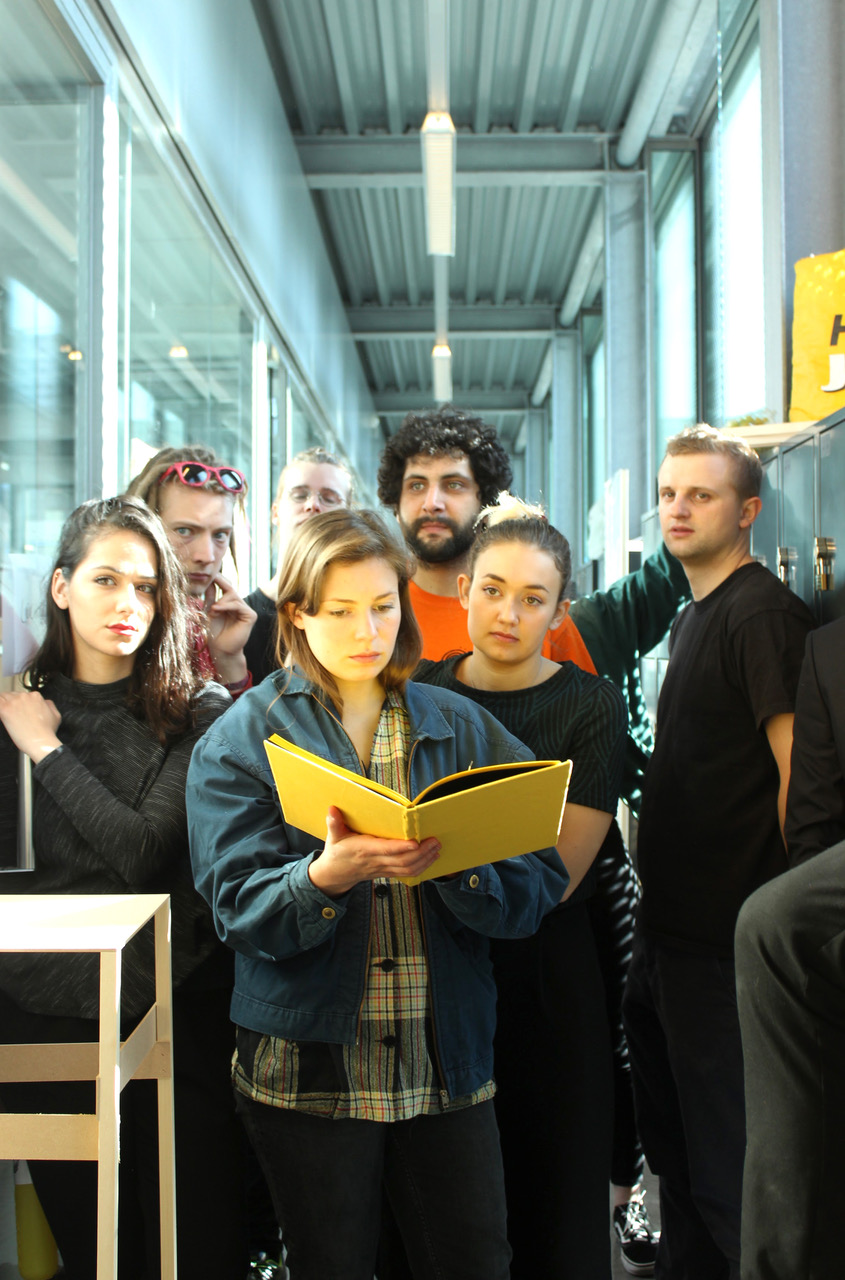
Scholten, J. (2017), Students taking over the corridors. Part of the section: Pedagogic practices and strategies, ENLARGE THE CLASSROOM: Take over the corridors.
We do this to perceive and use space differently and extend the borders of the classroom, to facilitate random encounters.

Continue reading

One Press Many Hands:
APHA Conference Notes

Not long ago, I had a revelation:

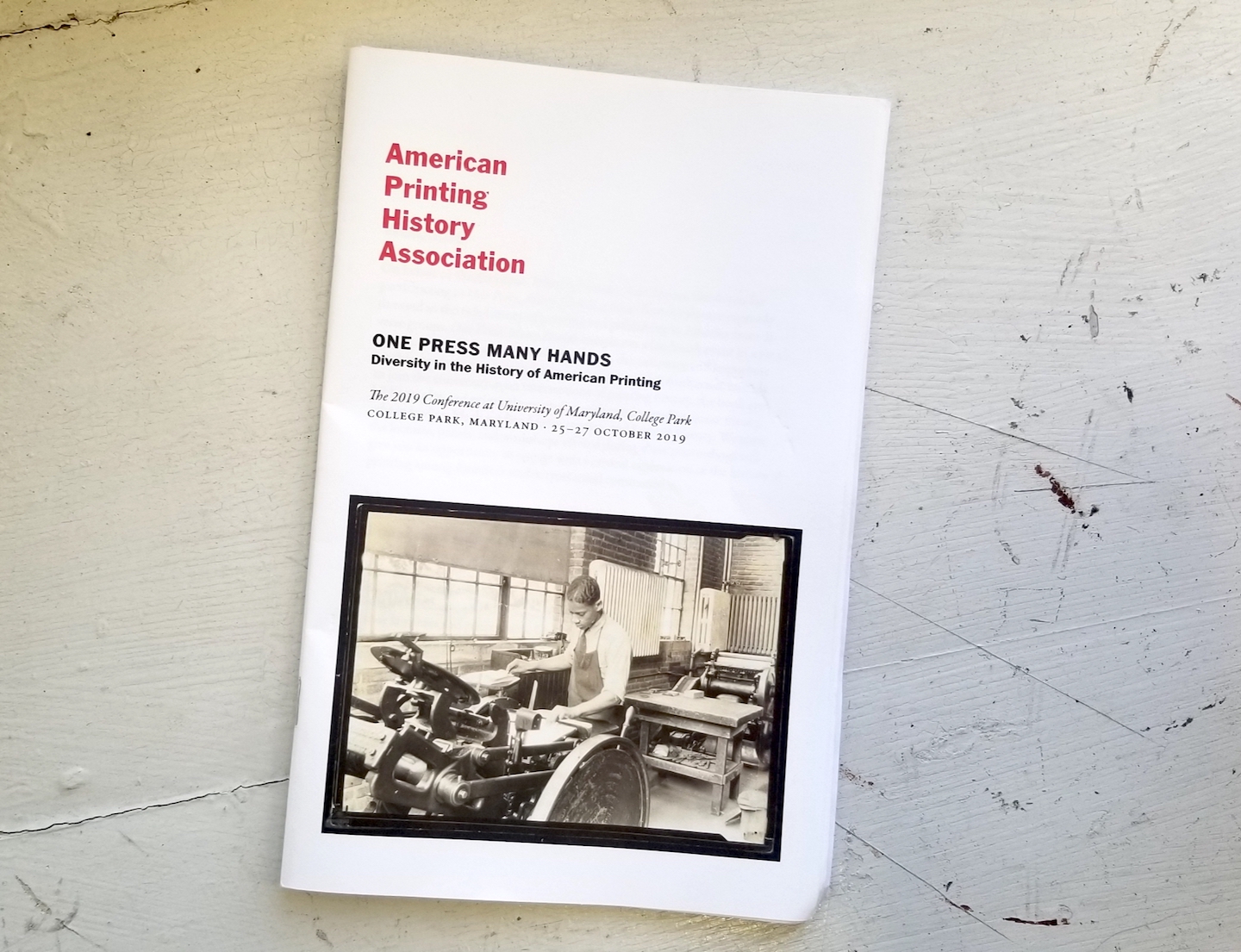
The American Printing History Association (APHA) 2019 conference, “One Press Many Hands: Diversity in the History of American Printing”, held at the University of Maryland, College Park last weekend, proved this theory correct. Just to be clear, I love all sorts of nerds, and identify with many nerd cultures: type nerds, tech nerds, type tech nerds, you get where this is going. But there is something about printing history that’s uniquely wonderful. Any of these nerd groups could show up at the APHA conference, enjoy talks related to their own flavor of nerdy, and learn about a tangentially-related topic. The Venn diagram of printing history includes almost all of the nerd circles I love and why I felt so warmly welcomed, despite butchering the pronunciation of APHA during my talk. (For those not in the know, it’s “AHH-FAH” not “A P H A” 🤦‍♀️ and no one even publicly flogged me for it. AIGA? TDC? It was a reasonable guess!)

cover of conference program features a historical image of a young African American man working at a press

Continue reading

List of resources on designing diacritics

Aleksandra Samuļenkova shared this list of ‘sources concerning diacritics and special characters of the Latin script’ which is just too good to be buried on Twitter.
It would be great if we could all add more tips in the comments!

• An essay by Victor Gaultney on Problems of diacritic design for Latin script text faces

• An article by David Březina On Diacritics

• A great book about Central European diacritics: The Insects Project

Continue reading