Goodbye to the Master of the Univers

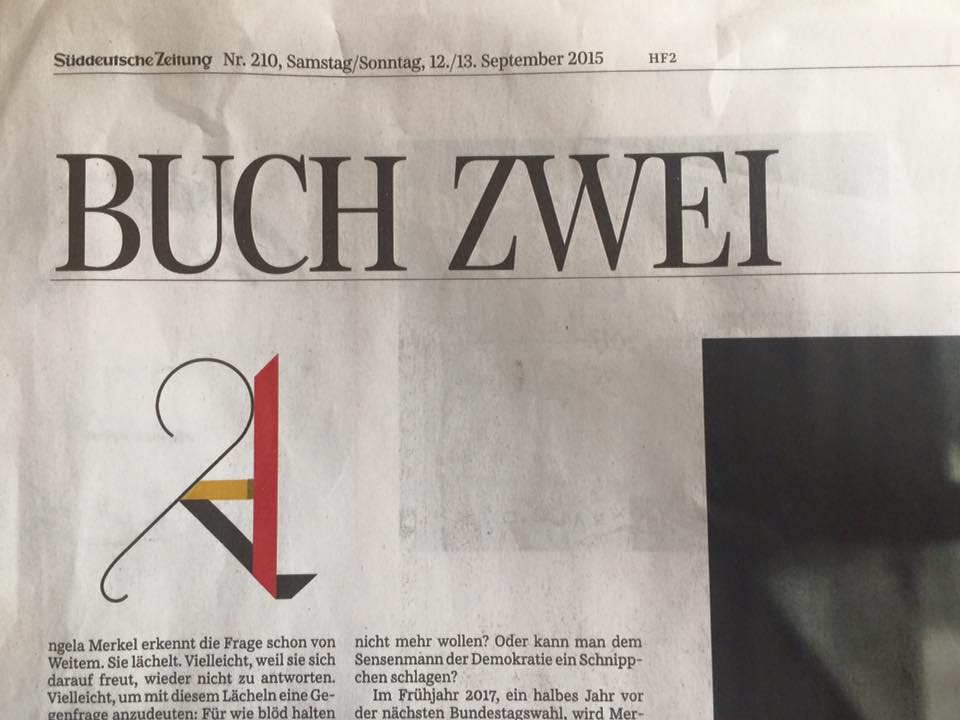
This past week Adrian Frutiger (24.05.1928–10.09.2015) passed away after a life full of passion for typography and type design. This is the second great loss for the type community this year — he followed another type legend, Hermann Zapf, who died in June. In the 1950s, when he designed the famous font family UNIVERS, he could barely imagine that today such ornamental, playful initials would be used in a daily newspaper. He accompanied my life as a designer from the beginning of my studies in the ’80s, and I always loved the rhythm of UNIVERS — even today, and going forward. Farewell and have a good last journey.

Adrian Frutiger - Master of the Univers

Rooibos Tea & Pistachios – Talking with Alice Savoie

I always find it interesting to talk to people. And more than that – to talk to other ladies that are doing similar things like I do, experience the same dilemmas, and most likely share with me some feelings. This series of interviews aims to give us an insight about the lives and work of the Alphabettes.

The structure is simple: Three sections with different length of answers to allow skimming or reading (aren’t we all so busy?). “The warmup” with short questions, “The visual” with photos taken by our interviewee as replies, and “The longer bits” of questions that require some more words to answer to, and probably more thought.

Each interviewee will nominate the next lady to be interviewed, out of our lovely Alphabettes. The last paragraph will also give us a preview of the next interview, with a question passed along for next post.

So grab a coffee or a freshly squeezed orange juice and start reading. Hope you’ll enjoy Alice’s answers just as I did!

Continue reading

A Lovely Night Out with the Ladies

Over the long Labor Day weekend, I had a lovely evening meeting several ladies in type. In some respects, it was one of those moments where you suddenly realize that you’re not quite alone in the world anymore as both a woman and creative individual. Sadly, it’s not often that you meet so many women in the creative field in one place. That being said, there should definitely be more opportunities to make it so.

In my early days after graduating college, I remember how shocked I was upon jumping into the corporate world of Typography and Design. Contrary to the gender-neutral classroom environment, the studios, agencies, and companies I worked for were overwhelmingly male-oriented. Could it be that women didn’t want to work at these places for specific reasons that I wasn’t seeing? If not, where did all these educated women go after they earned their diplomas?

Continue reading

Dissertations and Papers from Type Culture

Mark Jamra’s site Type Culture hosts a couple of very interesting research papers and similar texts, for instance:

Oldrich Menhart: Calligrapher, Type Designer and Craftsman
by Veronika Burian

This extensive dissertation presents the versatile work of the great Czech calligrapher and type designer Oldrich Menhart in his most unique and interesting period between 1930 and 1948.

French Type Foundries in the Twentieth Century
by Alice Savoie

The value of this dissertation lies not only in what it imparts to the reader, but also in its rarity, since relatively little information on the recent history of type in France has been written in English. To people who are less than fluent in French, most information about the state of affairs in French type and typography is woefully out of reach. This well-written study focuses on the activity of French foundries, their fateful decisions regarding the adoption of new technologies and the evolution of French type design throughout the last hundred years.

Continue reading

In the Middle of Nowhere

L1040374_wp

In the middle of nowhere – an encounter First published in 2008 at SLANTED

I’m now on my way to Roquefort, after a halfway sleepless thundery night in a tent on the French Atlantic coast. I couldn’t tell if this is the place where the famous French cheese by the same name originates, but I do know that it is the place, central in the southwest of France where I will soon meet the man whose works I have studied, and come to appreciate, for some time now: his name is Jack Usine.

Continue reading