
One of the things I have thought about since that article came out is why I read that article the way I do, and why others did so differently. I am someone who would both benefit and is restricted by what this article puts forward as an action in point #4. How do I deal with this contradiction? India is home to a lot of scripts and languages. I have lived in various parts of the country and in doing so have had to learn a few of the languages spoken in those parts. My fluency in those languages today is at varying levels. How do I engage with the many scripts that I am familiar with? Can I design for one of the native scripts that I grew up with, which is different from the one I am most comfortable with? Everyone’s worldview affects the way they understand things and I realise how mine has affected my own understanding. This point makes me uncomfortable too. So I push myself to sit with this discomfort. Which is what has brought me to try and view this contested point #4 in non-binary terms. When people are expressing themselves in unfamiliar ways, I assume that my work is to understand their point and that healthy boundaries are essential for everyone to flourish. Allow me to explain this further.
Continue readingCall for mentors
The Alphabettes Mentorship program has been so successful that we are overwhelmed by the many mentee applications. This is great, but also means that we need to stop accepting new applications for the moment, until we have processed the open requests.
We are actually actively looking for new mentors. Over 100 mentees need YOU! Please consider sharing your experience with this wonderful and enriching community.
Thank you
Alphabettes Mentorship Team
Reflections on “It’s Time to Act”
Alphabettes is a diverse group of women from across the globe with a variety of backgrounds, views, and life stories. The article “It’s Time to Act” is an example of a collaborative effort aiming to respond to recent events and to raise difficult questions that our industry needs to engage with. Difficult questions are by nature controversial and are often highly emotive. One such question is the one raised in point 4 which calls for designers to stop taking design commissions for scripts they did not grow up with. This article will examine this issue and focus on 3 key questions: Is a designer able to design for a script they cannot read? If yes, should they? And finally, how can we as an industry support designers who come from disadvantaged backgrounds?
Continue readingIt’s time to act
The Alphabettes community is, at its heart, political. We are a global network of women, connected together by our love of letters, type, and typography. Our objective is to champion anyone who identifies as a woman in type, provide a platform for them to show and share their work, and welcome them to a community that will not ignore their voice, but amplify it. Alphabettes started through the joint effort of Indra Kupferschmid and Amy Papaelias in 2015, and since then the network has grown to include over 245 members worldwide. As a community, we aim to respect and reflect on the opinions of all of our members, and we continue to learn and grow together.
During the last two weeks and following the tragic murder of George Floyd at the hands of four Minneapolis policemen, the United States of America saw a powerful uprising opposing discrimination, violence, injustice, and systemic racism against Black people, the impact of which quickly rippled through the rest of the world. In a time when much of the world has retreated into their homes and maintaining social distancing has become a necessity for health, the urgency of protesting racism and discrimination and demanding justice has eclipsed a quiet survival. Since then, crowds of protestors have taken to the streets, statues glorifying racial bigots have been pulled down, and social media platforms have seen an overwhelming sharing of educational, supportive, and encouraging discourse regarding this call of eradicating racism. Donations have been made to individuals and organisations supporting this movement. No action is too small.
Continue readingFirst Mentees Q & A video meeting
After a successful Q & A for mentors we organised a Q & A online session for mentees. Two previous mentees, Tatiana Lopéz and Samar Zureik, kindly shared their experiences and tips, and answered many great questions by the video participants, either new or current mentees.
Clumsy lettering with personality
My initial motivation in learning lettering was to be able to create perfect, elaborate, admiration-inducing letters. In 2011 I completed a type design masters at EINA school in Barcelona, which also opened up the world of calligraphy and lettering in all sorts of styles for me. I ended up loving the brush. I wasn’t too good at first but after additional workshops, reference books —Brush Lettering: An Instructional Manual of Western Brush Lettering by Marilyn Reaves was particularly helpful— and hours of after-work practice, I finally tamed it. I even gave a brush lettering class. I felt pretty good about it. Then… I felt stuck. Most of what I was achieving was by the book but somehow felt bland and impersonal.
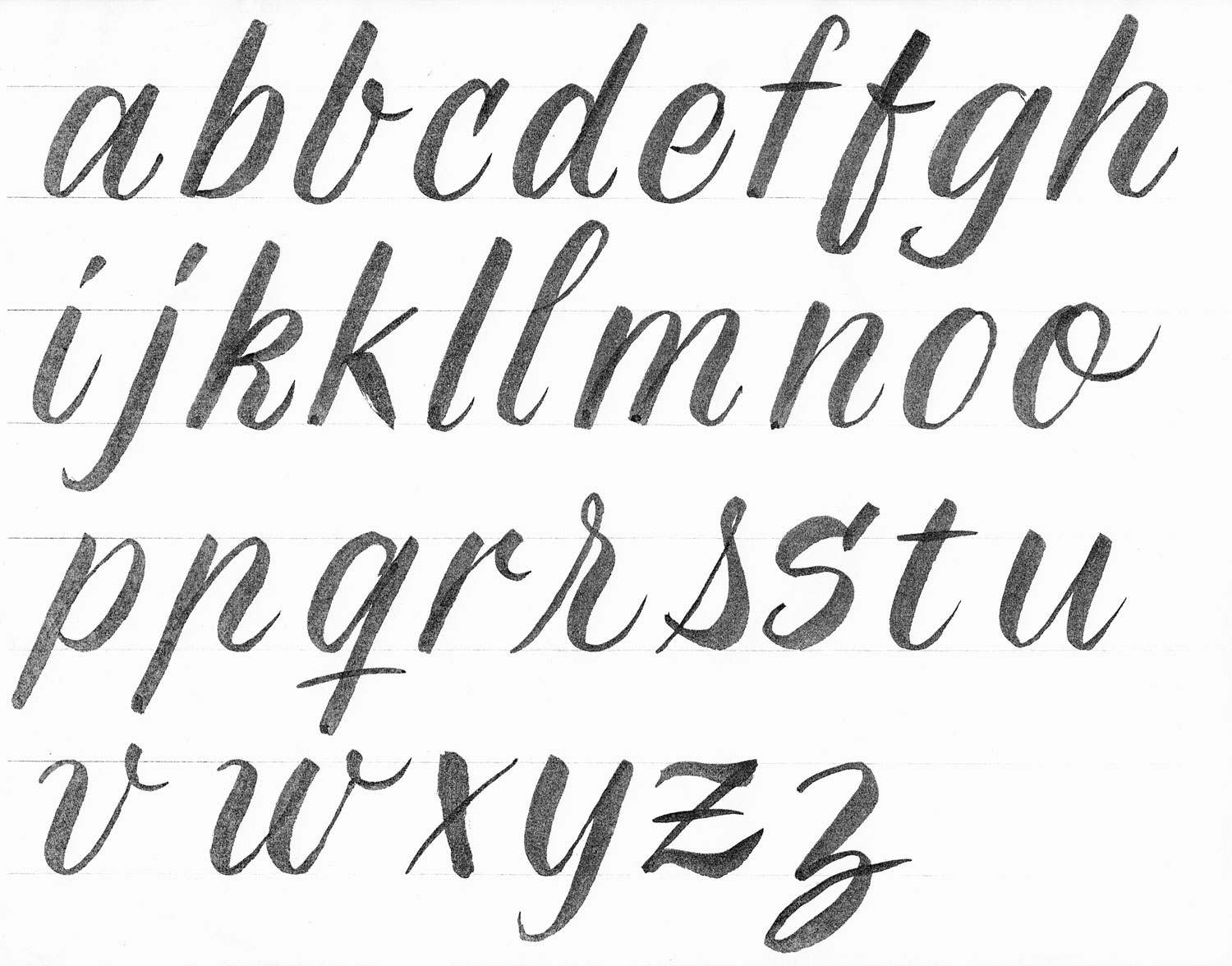
Reference alphabet I prepared for the brush lettering class I gave at the Spotify offices in Montreal in 2015.
Alphacrit: June 19, 2020
We’re at it again! This time we’ve got a special Alphacrit session with Sahar Afshar and Naïma Ben Ayed focusing on Arabic type design. Sahar and Naïma will offer constructive feedback to four participants on their in-progress typefaces via Zoom. Sol Matas will host the session to keep everything running smoothly. Keep reading to learn more.

Join us!
Alphacrit will be livestreamed as a part of Typographics TypeLabs on June 19 at 18:00 pm BST (17:00 pm UTC).
Follow @TypographicsNYC for the link or keep checking their website until details are available.